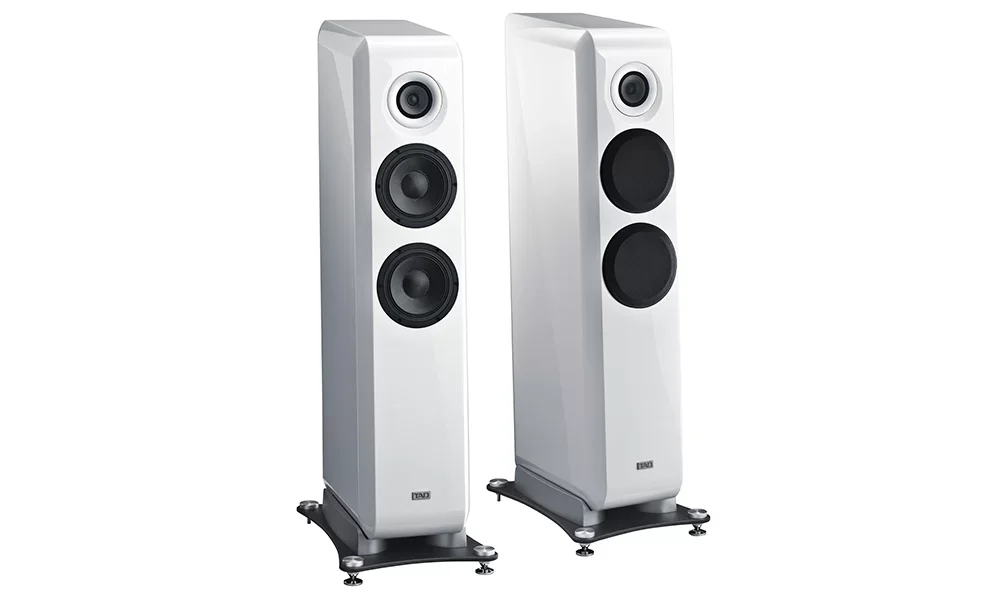
Glossy-white TAD E1AX with twin woofers and the CST driver above.
The three-way Evolution One combines an updated 9 cm CST assembly with twin 16 cm woofers. TAD E1AX develops the E1TX concept with revised drivers and internal acoustic tuning, in black or glossy white.
E1AX is a route to TAD’s concentric midrange/tweeter in a full floorstanding design. Its dedicated midrange separates voices from the bass drivers’ work, making the handover between bass weight and vocal expression a useful focus when comparing it with E2.
The CST update is more than a new name
A 25 mm vapour-deposited beryllium tweeter sits inside an anodised and coated magnesium midrange. TAD also revises the supporting basket. The concentric layout is intended to keep phase and dispersion coordinated as the two drivers exchange duties.
Twin woofers, with their own working range
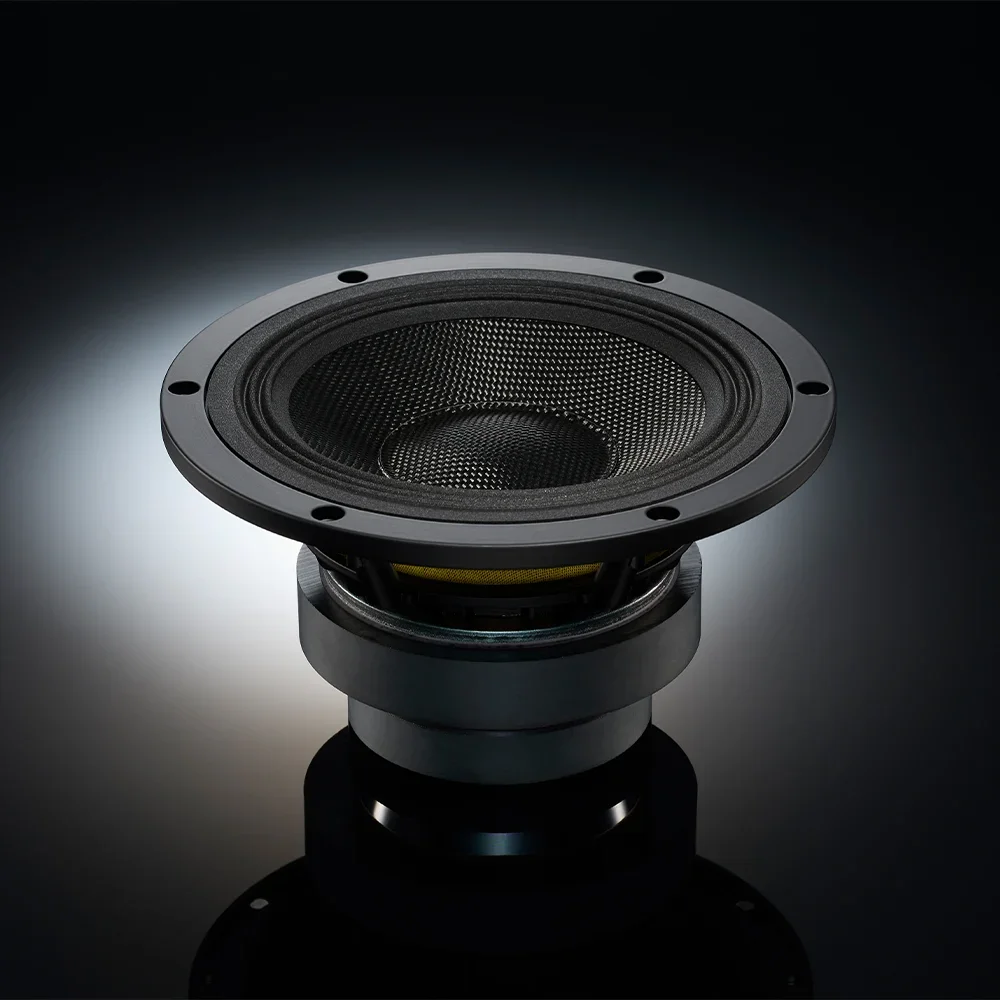
Two 16 cm MACC woofers handle the lower frequencies below the CST crossover at 420 Hz. Their layered diaphragms, magnetic circuits and basket design address stiffness, motion and airflow. The design gives E1AX a distinct three-way architecture rather than E2’s 2.5-way arrangement.
Control inside the cabinet
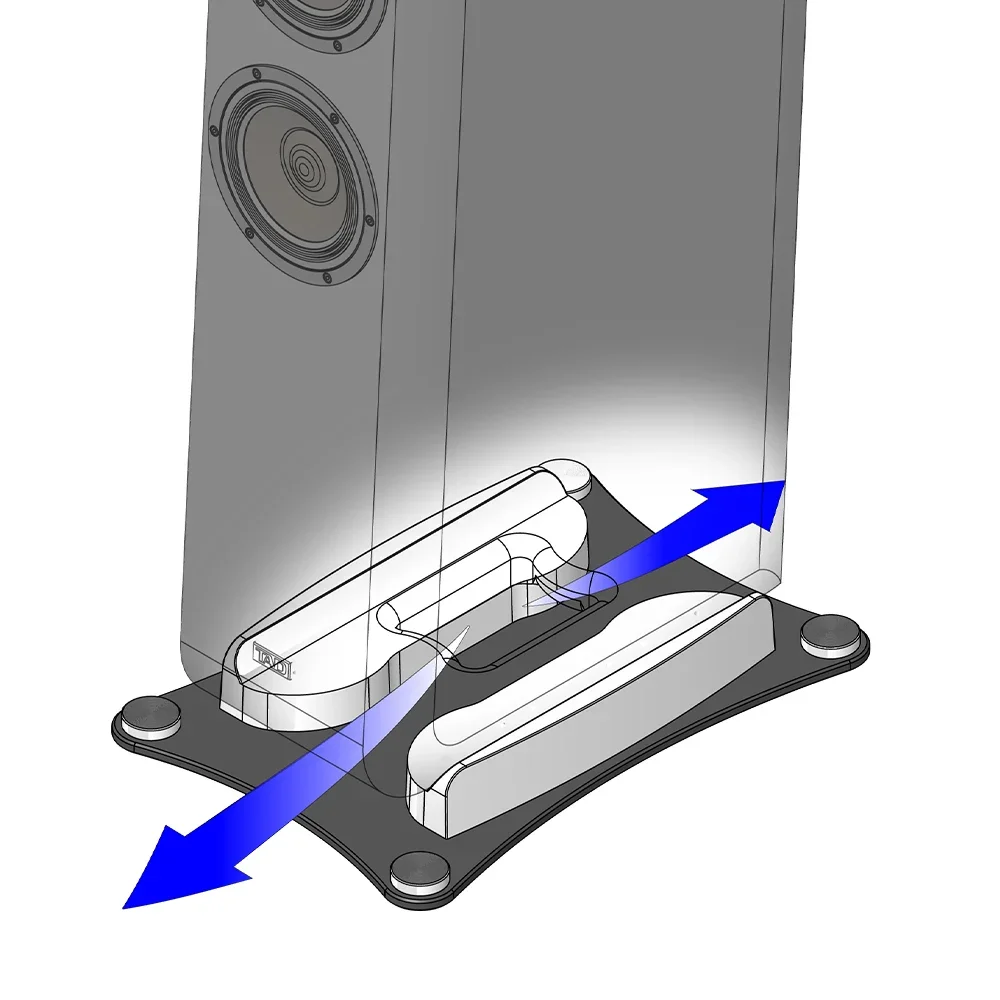
AFAST uses acoustic tubes to reduce low-order standing-wave modes inside the enclosure. The braced SILENT cabinet and bottom Bidirectional ADP port address vibration and airflow. AFAST is part of the loudspeaker construction, not electronic correction of your listening room.
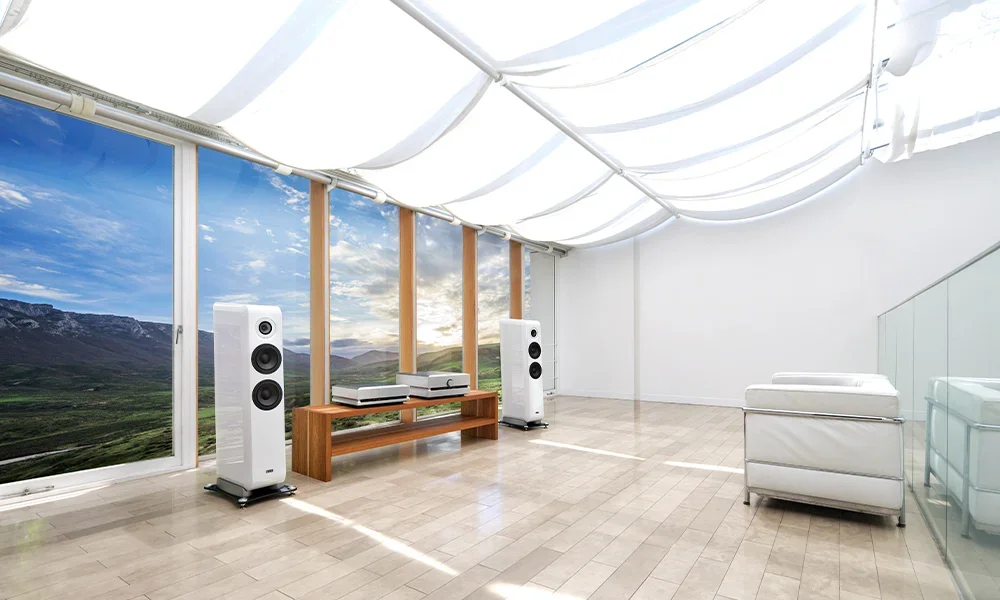
E1AX in a manufacturer listening-room setting, illustrating its floorstanding proportions.E1AX 16 cm MACC woofer assembly.Manufacturer cutaway illustrating the E1AX bottom port and front/rear airflow.
How it compares
E1AX succeeds E1TX with the updated CST, revised driver structures and AFAST enclosure tuning. GE1 moves to a larger 14 cm CST and twin 18 cm woofers, compared with E1AX’s 9 cm CST and twin 16 cm units. Compare their physical scale and system demands as well as their published response ranges.
Amplification, support and placement
E1AX is a passive, nominal 4 Ω loudspeaker. Its 88 dB sensitivity is measured at 2.83 V / 1 m; amplifier matching depends on listening distance, peaks and load capability.
Each cabinet weighs 54 kg and is 518 mm deep. Check the delivery route, intended support position and cable clearance before finalising a system.
Positioning the pair
Keep the bottom port’s forward and rearward openings clear. Start with a symmetrical layout, then adjust toe-in and boundary distance while listening for a stable vocal centre and even bass. Internal AFAST tuning does not remove the need to find a suitable position in the room.
TAD E1AX specifications
Design
3-way bass-reflex floorstanding
Drivers
Two 16 cm woofers; 9 cm magnesium midrange / 25 mm beryllium tweeter CST
Frequency response
29 Hz to 60 kHz
Crossovers
420 Hz; 2.5 kHz
Sensitivity
88 dB (2.83 V / 1 m)
Nominal impedance
4 Ω
Maximum input
200 W
Dimensions (W × H × D)
347 × 1,146 × 518 mm, without spikes
Weight
54 kg per speaker
Specifications are published by TAD. Frequency response describes the loudspeaker under the manufacturer’s conditions, not the response at your listening seat. Maximum input is not a recommended amplifier rating.
Yes. TAD introduced E1AX as the successor to E1TX, with an updated CST driver, other driver refinements and AFAST tuning inside the cabinet.
Does AFAST correct the room electronically?
No. It is an acoustic arrangement inside the speaker cabinet. It does not measure the listening room, apply DSP or remove room-mode problems.
What distinguishes E1AX from GE1?
GE1 uses a larger 14 cm CST and two 18 cm woofers, while E1AX uses a 9 cm CST and two 16 cm woofers. GE1 is also larger and heavier. Neither comparison alone establishes which will work best in your room.
AUSTRALIAN ENQUIRY & SUPPORT
Enquire about TAD E1AX
Tell us what you would like to know about this model. Your amplifier, listening distance and preferred finish help us discuss system fit and confirm the supply options for your enquiry.