
FREE ROOM BASS ANALYSIS
Explore how your room may affect bass.
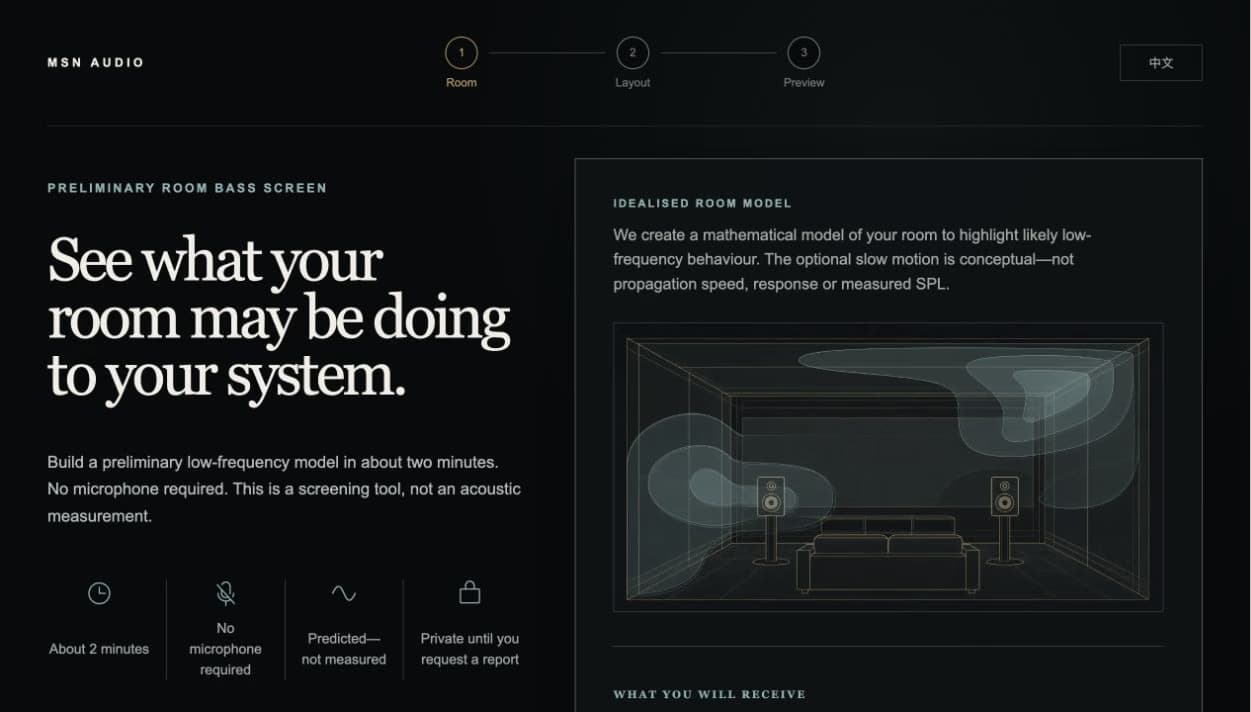
Enter your room dimensions and the positions of your speakers and seat to see predicted bass resonance frequencies and pressure patterns. No measurement microphone is needed. The results describe an idealised rectangular room, not measured sound in your home.
Free · No measurement microphone needed · Opens in a new tab
What can you learn from the result?
- Which predicted bass frequencies may be worth investigating.
- How speaker and listening positions may affect bass in the model.
- How the room shape and information you enter affect the confidence in the result.
- Which questions need an actual measurement to answer.
What to have ready.
- Your room shape and dimensions, including relevant openings.
- The positions of your speakers, listening seat and any subwoofers.
- A little information about your system and what you notice when listening.
You do not need acoustic measurements. If a dimension or position is estimated, make that clear in your inputs.
From your room to a useful starting point.
Describe your room.
Enter the shape and dimensions. The tool checks which predictions it can offer for that room.
Add your system and positions.
Enter the speaker and seat positions, then answer the listening and system questions. You can review and edit the numbers without using 3D.
Explore the preliminary result.
See areas worth checking, how much confidence to place in the model and what could be investigated next.
Understand what the model can tell you.
The tool uses your room shape and inputs to decide which predictions it can provide. Where the room is not suitable for a model, it explains the limitation. Room shapes do not all support the same level of prediction.
It cannot determine actual peaks and dips in sound level, lingering bass or treatment results. It does not generate EQ settings or prescribe product quantities. Those decisions need evidence from your real system and room.
Before you submit information, the tool explains what it collects, why it is needed and how long photos and reports are kept. Report consent is requested separately from optional marketing consent.
Explore your own room.
Use your dimensions and layout to find questions worth investigating. If you would like someone to listen and measure with you, you can also explore our in-home service.