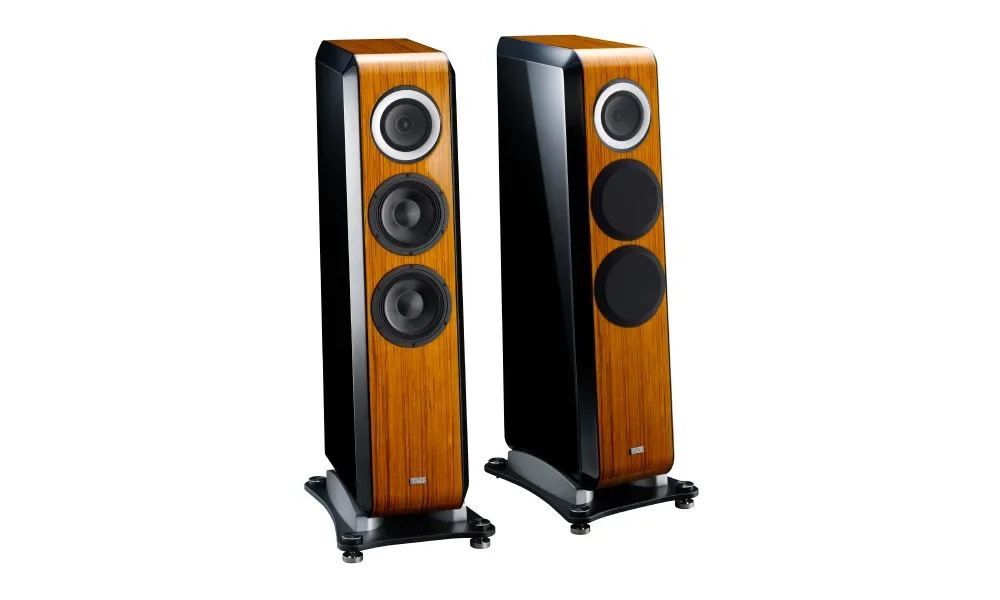
TAD GE1 in wood finish, with and without its woofer grilles.
TAD GE1 combines a 14 cm CST assembly with twin 18 cm woofers in a 64 kg floorstanding enclosure. Its larger Evolution platform adds an isolated CST mounting system and internal acoustic tuning.
Grand Evolution One combines the scale of twin bass drivers with a CST assembly isolated from the enclosure. TAD uses that separation to limit vibration reaching the midrange and tweeter. For a listener who enjoys layered orchestral or live recordings, a useful comparison is whether individual voices and instruments remain easy to follow as the music becomes more demanding.
A shared axis for voices and overtones
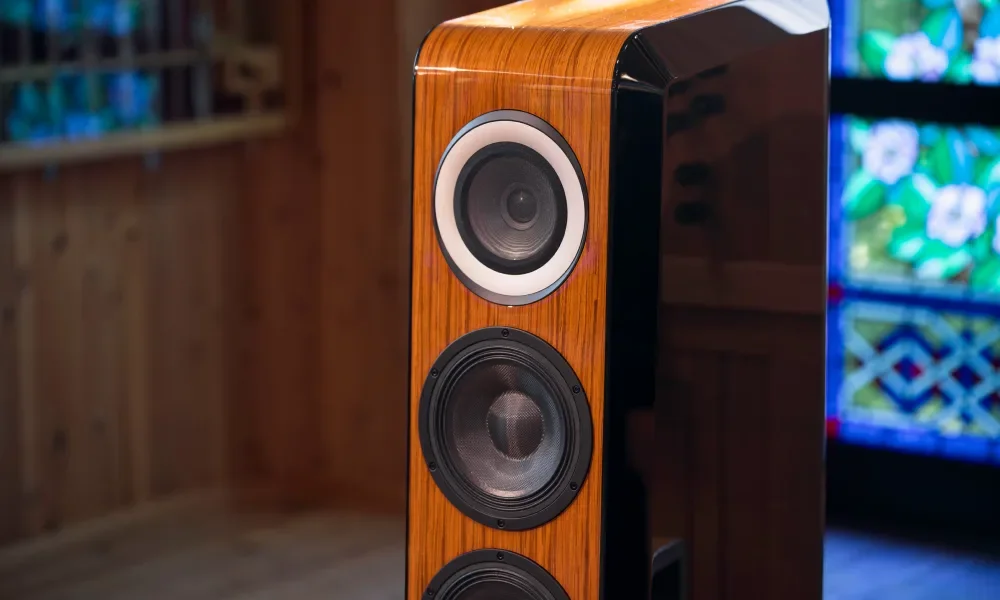
The 14 cm magnesium midrange and 35 mm beryllium tweeter form the CST assembly. Their concentric arrangement is intended to coordinate dispersion through the crossover. The single-axis concept is aimed at coherent imaging, including when music becomes layered and complex.
Isolation at the CST mount
GE1’s ISO Drive mounting uses a machined aluminium base and damper bushes to separate the CST mechanically from the enclosure. This addresses vibration transfer between the midrange/tweeter, cabinet and bass drivers, rather than relying on cabinet mass alone.
Bass drivers and enclosure work together
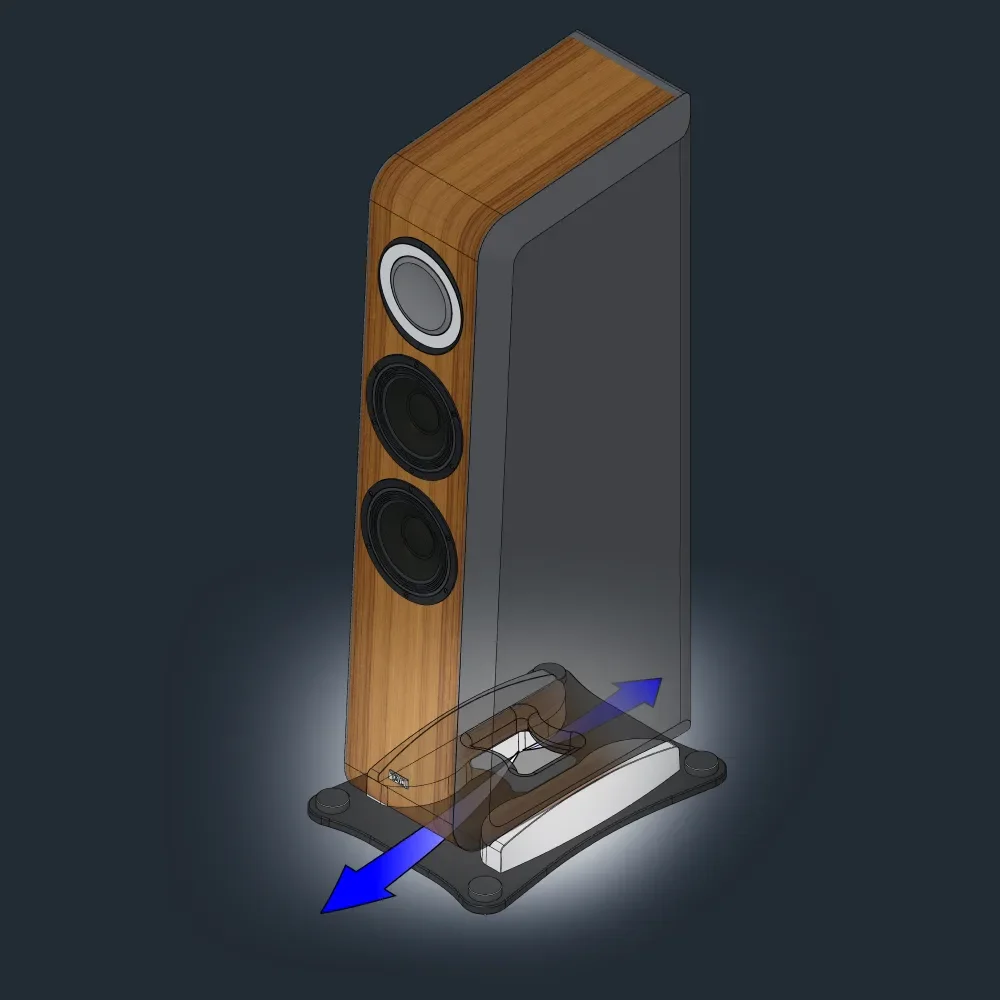
Two 18 cm MACS II woofers use five-layer composite diaphragms. AFAST acoustic tubes address standing waves inside the SILENT enclosure, and the bottom ADP port opens forwards and backwards. These are complementary approaches to driver motion, internal resonance and airflow.
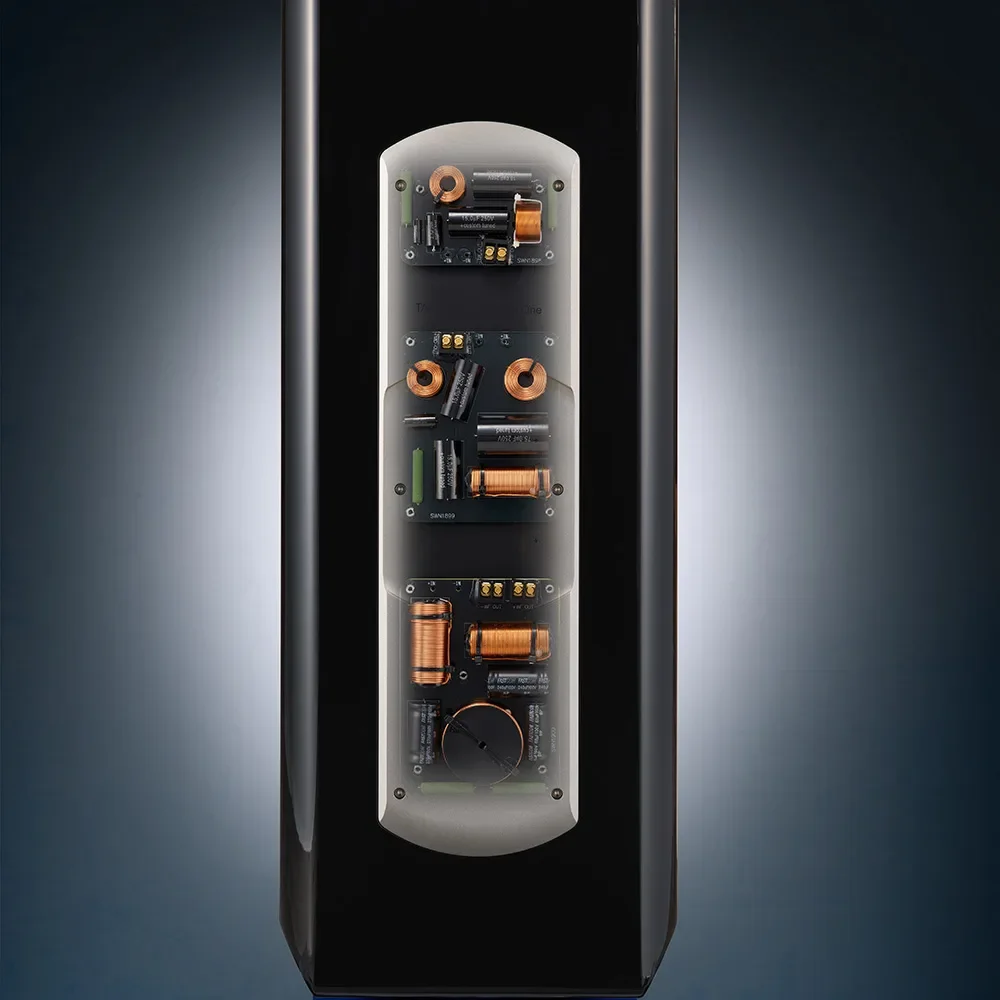
GE1 front baffle, CST driver and curved wood enclosure.GE1 enclosure cutaway showing the bottom Bidirectional ADP port.GE1 crossover assemblies inside the enclosure.
How it compares
CE1TX uses a 14 cm CST and one 18 cm woofer in a standmount cabinet. GE1 uses those driver sizes in a twin-woofer floorstander with ISO mounting. E1AX is a smaller floorstanding alternative with a 9 cm CST and two 16 cm woofers. The extra GE1 cabinet size is a practical part of the decision.
Amplification, support and placement
The nominal impedance is 4 Ω and sensitivity is 88 dB at 2.83 V / 1 m. Use suitable external amplification with enough capability for your listening distance and desired peaks.
Allow for 394 mm width, 547 mm depth and 64 kg per speaker, plus placement and cable clearance. Plan the route into the room and the final support position before installation.
Positioning the pair
Give the front and rear port exits free space. Adjust wall distance, speaker spacing and toe-in around the actual listening seat. AFAST works inside the enclosure; the room can still reinforce some bass notes and reduce others.
TAD GE1 specifications
Design
3-way bass-reflex floorstanding
Drivers
Two 18 cm woofers; 14 cm magnesium midrange / 35 mm beryllium tweeter CST
Frequency response
27 Hz to 100 kHz
Crossovers
250 Hz; 1.8 kHz
Sensitivity
88 dB (2.83 V / 1 m)
Nominal impedance
4 Ω
Maximum input
250 W
Dimensions (W × H × D)
394 × 1,212 × 547 mm, without spikes
Weight
64 kg per speaker
Specifications are published by TAD. Frequency response describes the loudspeaker under the manufacturer’s conditions, not the response at your listening seat. Maximum input is not a recommended amplifier rating.
It is the CST driver’s isolated mounting arrangement. A machined aluminium base and damper bushes reduce mechanical vibration transfer between the driver and enclosure. It is not a room-isolation platform.
Is GE1 a Reference Series model?
No. Grand Evolution One belongs to the Evolution Series. Its CST has a magnesium midrange and beryllium tweeter; the Reference CR1TX and R1TX use beryllium for both.
Does GE1 need a separate speaker stand?
No. GE1 is a floorstanding design with a base and supplied support accessories. Its substantial weight makes the installation route and stable final position important.
AUSTRALIAN ENQUIRY & SUPPORT
Enquire about TAD GE1
Tell us what you would like to know about this model. Your amplifier, listening distance and preferred finish help us discuss system fit and confirm the supply options for your enquiry.