
Why room modes make bass uneven and slow to fade
Bass waves reflect between the room's boundaries. At certain frequencies, those reflections form resonances called room modes. Their pattern produces stronger bass in some places and weaker bass in others. This is one reason a note can sound heavy at the sofa but much quieter a short distance away.
There is also a time dimension. When the room loses that stored energy slowly, the bass continues after the original note has stopped. Frequency response describes the uneven level; decay describes how long the energy takes to fade. Both affect how clearly we hear successive bass notes.
How two subwoofers take an active role in the room
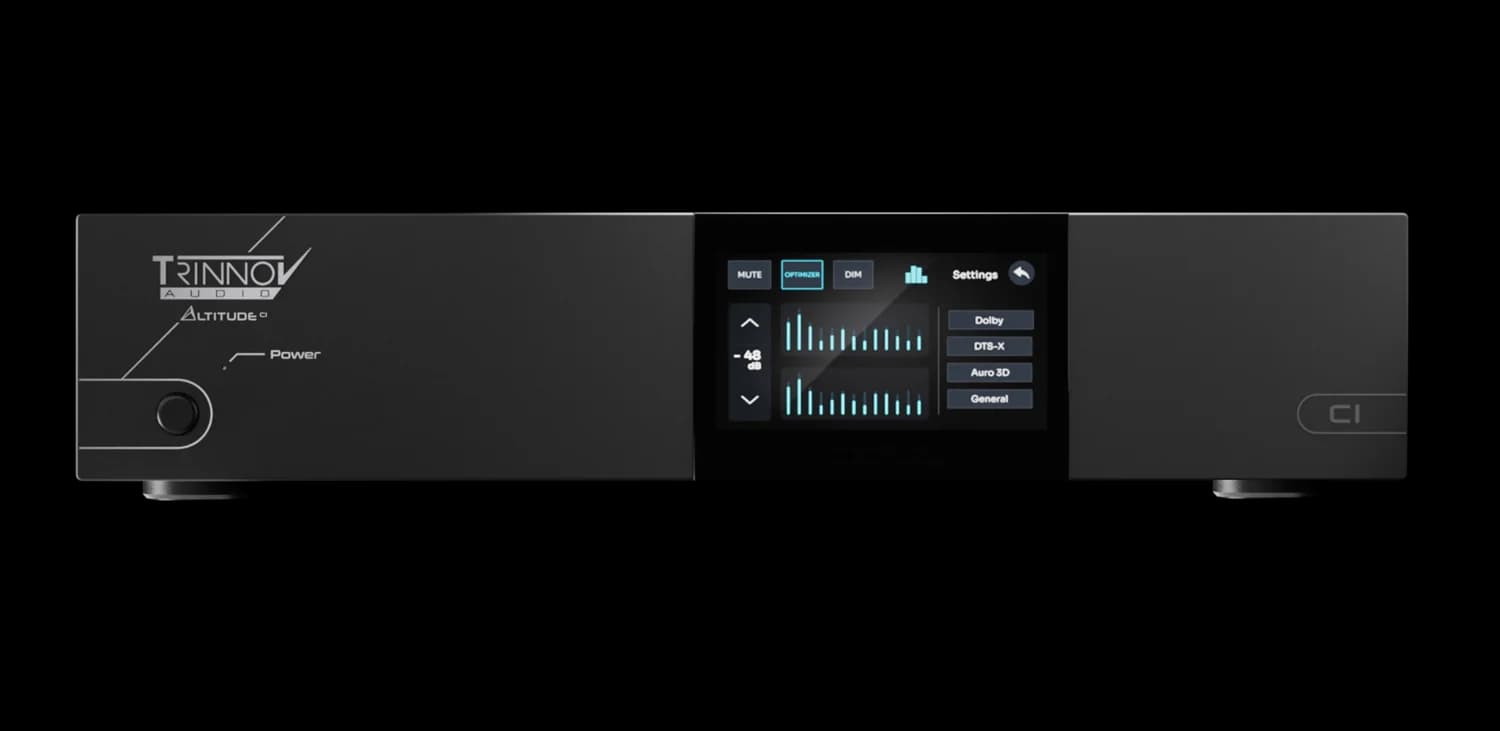
After measuring the room, the Altitude calculates the signals for the subwoofers. WaveForming controls their amplitude and phase so they contribute both to the intended bass wavefront and to active absorption of unwanted energy. The front subwoofers also act on reflections returning from the back of the room.
Trinnov's September 2026 research showed that two front subwoofers could provide useful control without a rear array. They need to follow Trinnov's placement guidance, with the strongest benefit around one or two seats or a compact listening area. This gives rooms without space for rear subwoofers a practical way to use the technology.
What did Trinnov measure?
In its two-subwoofer research announcement, Trinnov reports a reduction in decay time of up to 50% below 100 Hz with two correctly positioned front subwoofers. The company describes testing across different rooms, subwoofer models and listening arrangements, alongside a smoother frequency response through modal control.
Decay time describes how long the bass energy lingers after the sound has stopped. Shortening it helps explain the cleaner end of a drum hit and less overlap between successive notes. The 50% figure is the maximum reported in the manufacturer's testing, not a measurement by MSN Audio; the result in a particular room depends on its layout, equipment and calibration.
Why it matters for music and home cinema
In music, an even bass line lets you follow the player's phrasing instead of hearing a few notes dominate. Shorter room decay can also make the end of a kick-drum hit easier to distinguish from the next beat. These are useful things to listen for when comparing WaveForming settings in a stereo system.
A home cinema puts the same room to work with different material. A low-frequency impact should have a clear ending, while a sequence of effects benefits from less lingering bass between events. WaveForming acts on the room and subwoofer system in both cases. The design changes with the seats to be covered and the output the system needs.
What rear subwoofers add
Rear subwoofers can intercept back-wall reflections sooner, before that energy travels back through the listening area. This gives a front-and-rear arrangement more control over decay and helps maintain consistent bass across a wider area. For a larger seating area, it is a useful extension of the two-front-subwoofer approach.
The room determines how many subwoofers are useful, their spacing and height, and how they are grouped. Some supported arrangements let several subwoofers share a processor output; others need separate channels. The wiring follows the acoustic design. Adding a rear array also calls for a new calibration for that layout.
Two front subwoofers
The front pair reproduces bass and helps absorb returning reflections, with the strongest benefit around the main seats.
Front and rear arrays
Rear subwoofers act on back-wall reflections earlier, helping extend consistent bass to a wider listening area.
Bringing WaveForming into an existing system
Start with the front-wall positions you can use and the listening area that matters to you. Room dimensions, openings and placement restrictions affect the design, while the subwoofers need enough output for your listening level. Leave space for their cables, the processor's ventilation and microphone access during calibration.
In a stereo system, bass management sends the low frequencies from the main channels to the subwoofer system. In home cinema, it also needs to accommodate the soundtrack's LFE channel. The crossover and timing settings bring that bass back together with the main speakers, so the whole system works as one.
The September 2026 software release introduced the two-front-subwoofer option in Altitude CI 2.2 and Altitude16/32 4.4.5. Existing WaveForming presets can receive the algorithm improvements by running Compute after the update; a changed subwoofer layout requires its own calibration. Amethyst supports Optimizer and bass management, but not WaveForming. Amplitude16 supplies power amplification.
Choose the Altitude model around the connections and independently processed channels you need. CI has eight physical analogue outputs alongside digital and network options. Altitude16 has sixteen analogue outputs and additional digital channels; Altitude32 offers larger analogue configurations. The licence must cover the required processing channels. Source formats, volume control and the inputs of any DAC, power amplifier or active speaker complete that connection plan.
Listening and measuring the change
Compare familiar tracks or film passages at similar perceived levels. Listen for more even bass notes, a cleaner end to low-frequency sounds and the way successive events remain distinct. A frequency-response comparison shows changes in level across the bass range; decay measurements show whether room energy is fading sooner.
Repeat the comparison at the main seat and nearby positions, using the same measurement locations each time. This reveals both the size of the improvement and the area over which it holds. It is especially useful when deciding whether two front subwoofers meet your needs or a rear array would help more seats.
Further reading and software history
The WaveForming technology overview explains the approach to low-frequency control. Trinnov's two-subwoofer research article and September 2026 release announcement describe the newer configurations and software. Sources reviewed on 13 October 2026.
The earlier subwoofer placement guide is still useful for understanding array design. It was written before the two-front-subwoofer option became available, so read its minimum configuration alongside the newer research.