
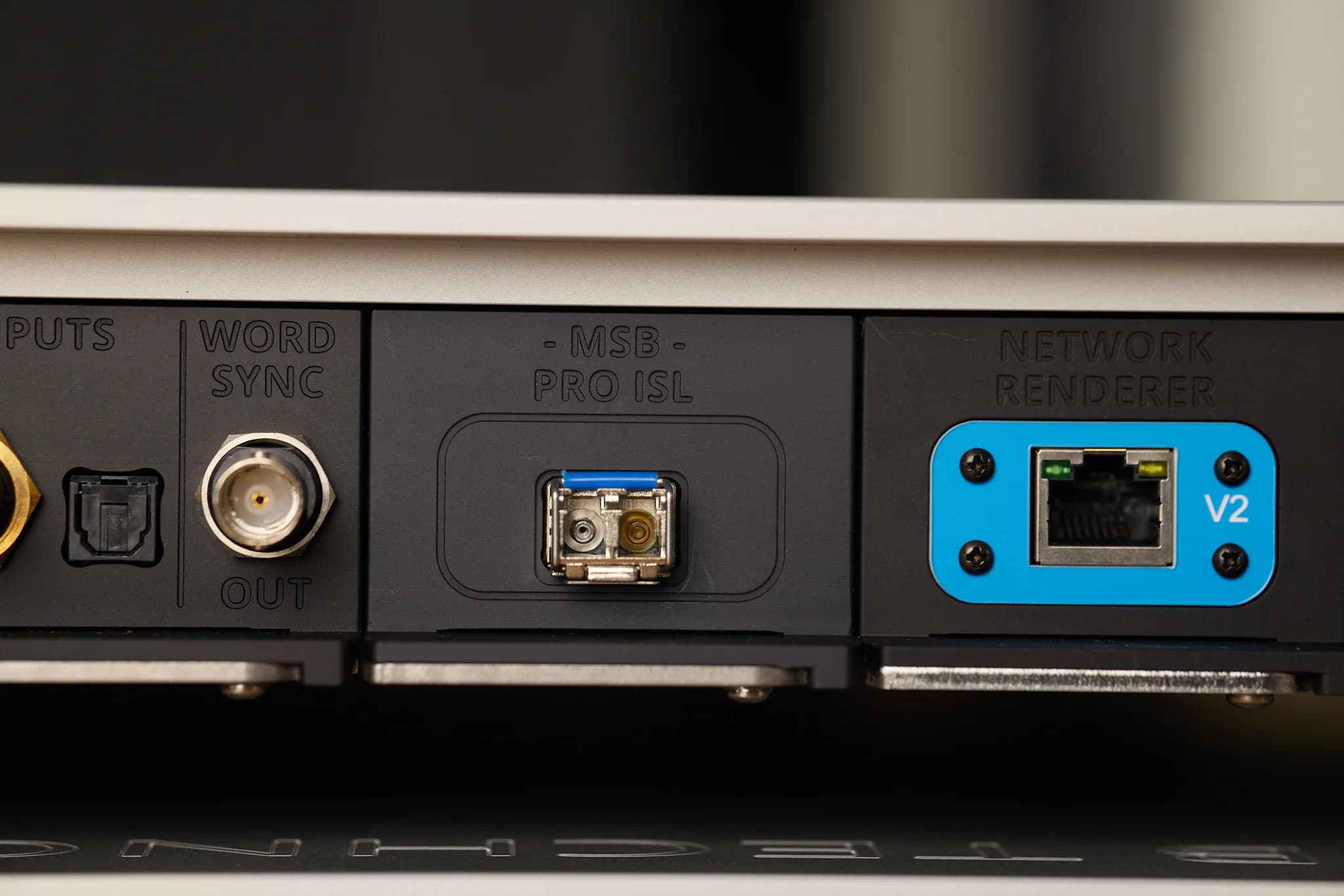
Why MSB designs its own discrete conversion modules
Most DACs use integrated converter chips from specialist manufacturers. That is a sound engineering choice: the chips are mature, consistent and capable, while the final product still depends on clocking, power, analogue output, PCB layout, software and thermal design.
MSB instead designs and manufactures its own discrete ladder modules. According to MSB, each module accepts raw digital data and produces a continuous voltage. The modules are fully balanced through the conversion point, individually shielded and thermally bonded, then measured and matched. Multiple modules can be used per channel to improve performance and lower output impedance.
Designing the discrete module gives MSB control over the switching network, conversion behaviour, component matching and output path. These are choices that would otherwise be set by the internal design of a general-purpose converter chip.
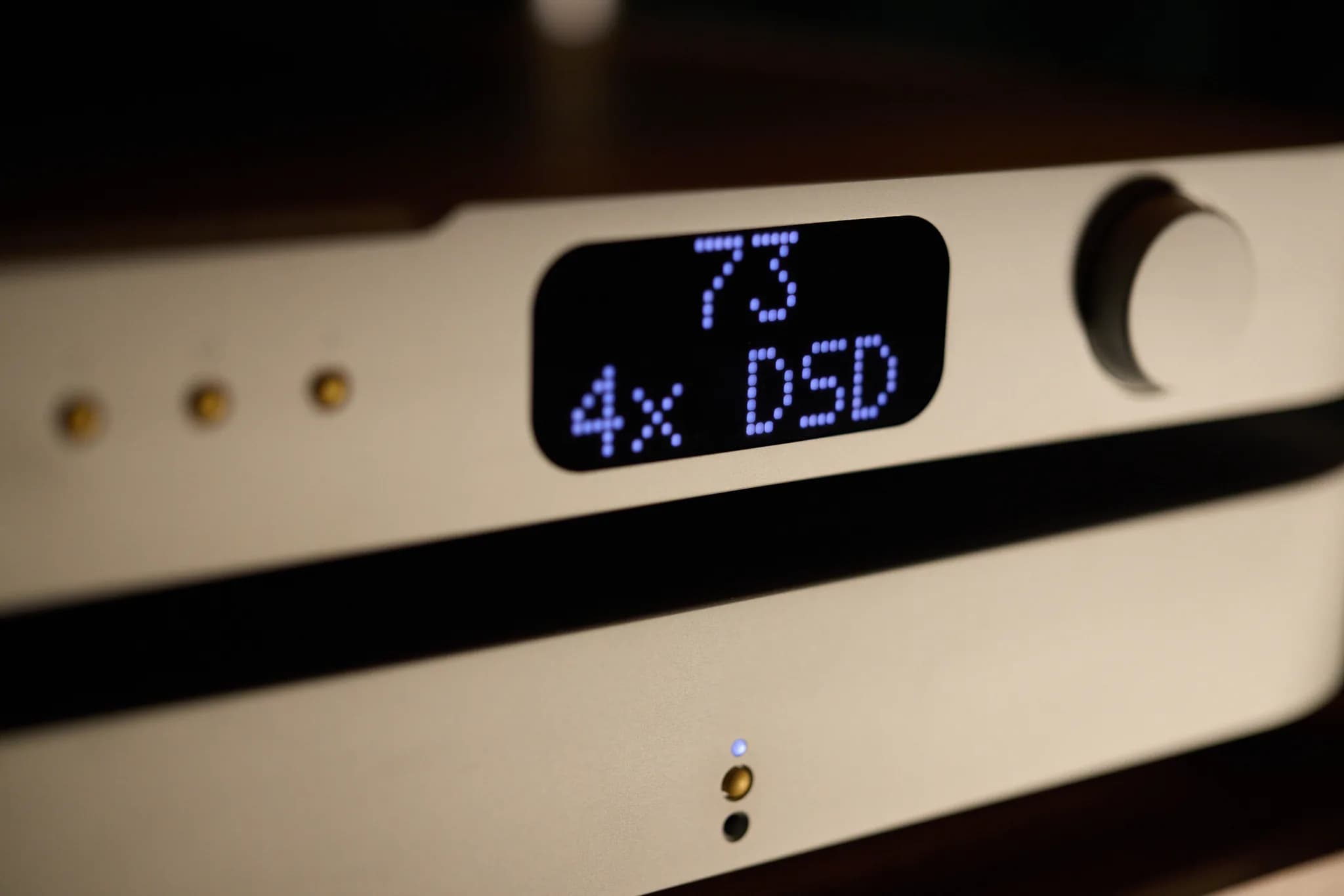
Why it is called Hybrid
Hybrid refers to two conversion modes within the same discrete module.
MSB states that its Hybrid and Prime DAC modules are dynamically configurable between two native discrete modes:
- Multibit PCM mode: the module operates as a discrete multibit ladder converter for PCM data.
- Parallel single-bit DSD mode: the same module is reconfigured as a large parallel single-bit converter for DSD data.
MSB also states that no buffer, conventional I/V converter, op-amp or transistor stage follows conversion in the signal path. The module creates the analogue voltage, which can then enter MSB’s output and volume-control network.
This is the central idea behind Hybrid: the format changes the conversion topology rather than being forced through one fixed mode.
Reading PCM specifications without turning them into a ranking
PCM represents each sample with a multibit value at a defined sample rate. Bit depth describes the available numerical resolution; sample rate describes how frequently the signal is sampled.
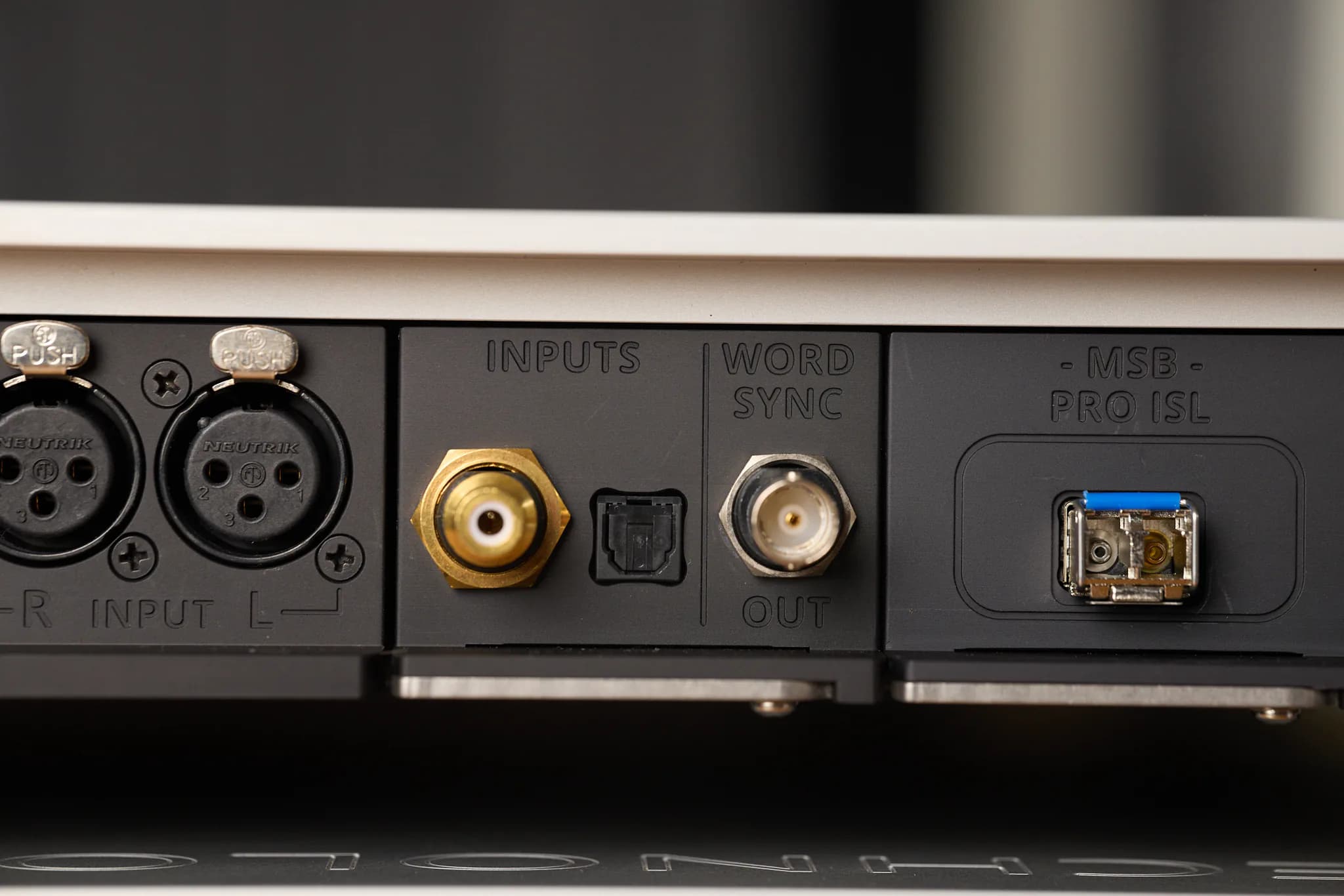
The Reference platform lists input-dependent support from 44.1 kHz to 3,072 kHz PCM up to 32 bits. That platform figure is not the same as the limit of every input module.
For example:
- Renderer V2 is specified up to 32-bit/768 kHz PCM.
- Pro USB is specified up to 24-bit/768 kHz PCM.
- Conventional SPDIF, Toslink and AES paths have their own source- and module-dependent limits.
“Supports 768 kHz” should therefore be followed by “through which input, with which firmware and source?”
It should not be treated as a sound-quality score. Most music libraries remain centred on 44.1, 48, 96 and 192 kHz material. High format limits indicate processing headroom and compatibility, but they do not make an ordinary recording more truthful by themselves.
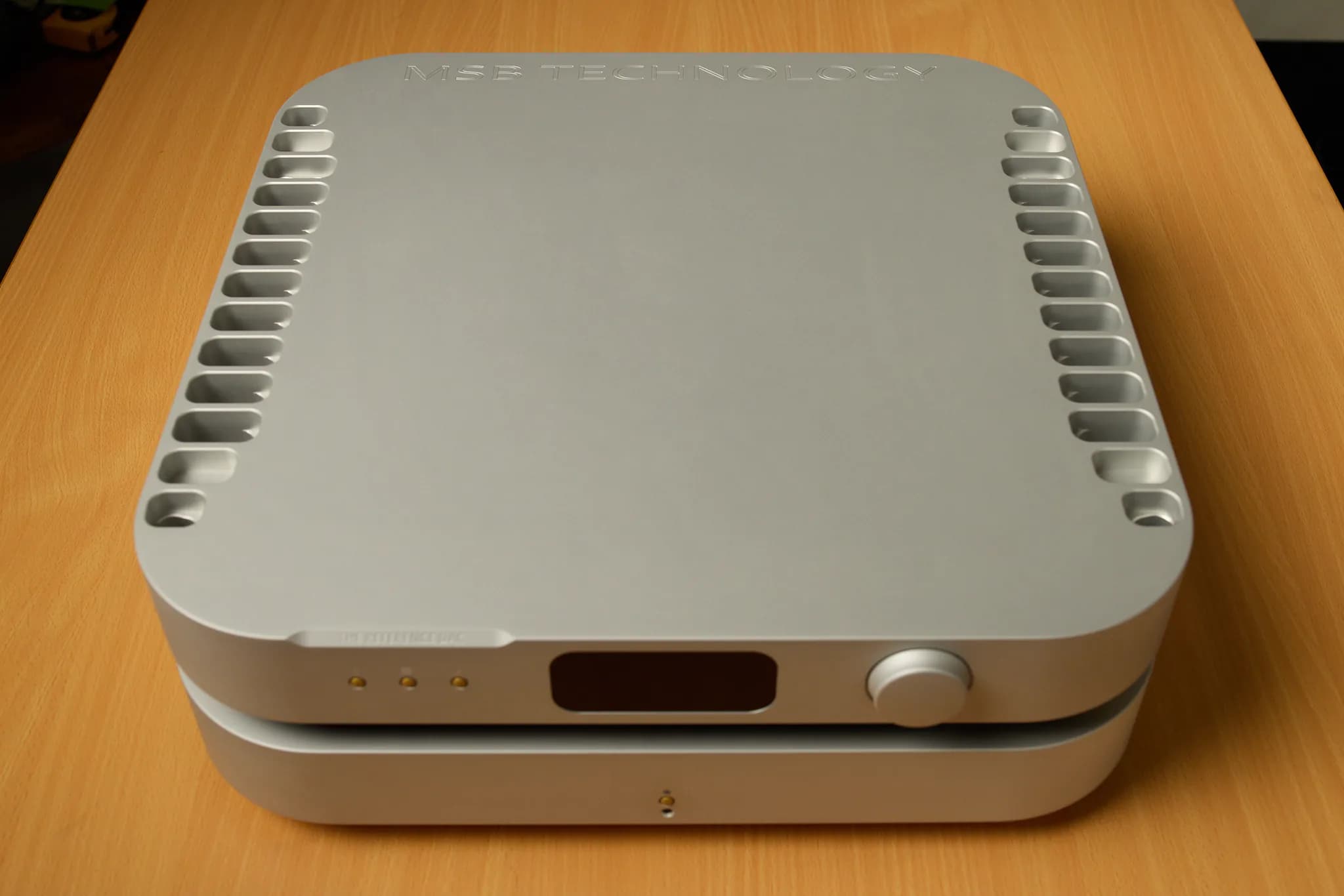
What 8× DSD and DSD512 mean
DSD represents the waveform with a very high-rate, single-bit stream. DSD64 runs at 2.8224 MHz, which is 64 times 44.1 kHz. Each step doubles the rate:
- DSD64: 2.8224 MHz
- DSD128: 5.6448 MHz
- DSD256: 11.2896 MHz
- DSD512, or 8× DSD: 22.5792 MHz
The Reference support specification lists 1×, 2×, 4× and 8× DSD, input-dependent. MSB’s Pro USB page explicitly supports 1× to 8× DSD when the compatible DAC and required firmware are present. Renderer V2 is specified up to 4× DSD.
Upsampling a DSD64 recording to DSD512 does not add information that was absent from the recording. It introduces a software modulator, filter choices and server processing. The useful question is what the complete playback chain does with the source, not how large a number appears on the display.
Native DSD, DoP and DSD-to-PCM are different things
These three terms are often confused.
Native DSD conversion
In this context, native DSD means the DSD stream does not first need to become PCM before the relevant conversion path. MSB’s Hybrid module changes to its parallel single-bit DSD mode.
DoP
DSD over PCM is a transport method. It packages the DSD bitstream inside frames that a PCM-capable interface can carry. The receiver identifies the markers, removes the packaging and recovers the DSD data. The presence of “PCM” in the name does not mean the music has necessarily been converted to PCM.
The Reference specification states that DSD via DoP is supported on all inputs, subject to the input-dependent format limits.
DSD-to-PCM conversion
This is an actual format conversion. The DSD stream is filtered and represented as multibit PCM before subsequent digital processing or D/A conversion. This approach can support digital volume control, EQ, room correction or a converter whose native internal path is multibit.
These paths solve different problems. They should not be grouped together under the single marketing phrase “DSD compatible”.
Is a native path automatically better?
Not by itself. Conversion, power, clocking and the analogue output all contribute to the complete implementation.
A native DSD converter with poor power, clocking or analogue implementation is not guaranteed to outperform a carefully designed DAC that converts DSD to PCM. Different releases of the same album may use different masters, and those mastering choices can dominate the comparison.
The engineering appeal of MSB’s approach is coherence. PCM and DSD each receive a conversion mode designed for the format, within the same fully balanced module and output philosophy. It avoids an obligatory format conversion when native DSD enters a supported path.
Whether that advantage is musically important still has to be heard with the actual files, source software, input module and system.
How I approach a PCM and DSD comparison
For a comparison, I prefer releases from the same master where possible, with matched playback levels and no unintended DSP. I also check whether the software sends native DSD, DoP or PCM, and note the input module, firmware and processing settings.
I listen for the start and decay of notes, changing harmonics, bass timing and how comfortable the recording remains over a longer session. A difference is worth describing, even when its cause cannot be isolated.
Architecture explains the route. Listening determines whether the route matters in the system.
Continue with Why MSB separates power, digital processing and analogue conversion or request an MSB private audition.