
reduction in the dominant 40 to 45Hz peak
CASE STUDYMelbourne two-channel listening roomRoom AcousticsAVAA C214Melbourne
Does an Active Bass Trap Really Work? We Measured AVAA C214 Before and After.
The biggest bass problem in this room was not simply “too much bass”. It was bass that stayed too long. We measured the same listening position before and after AVAA C214 to see what actually changed.
THE AFTER RESULT
What the room looked like after the C214 intervention
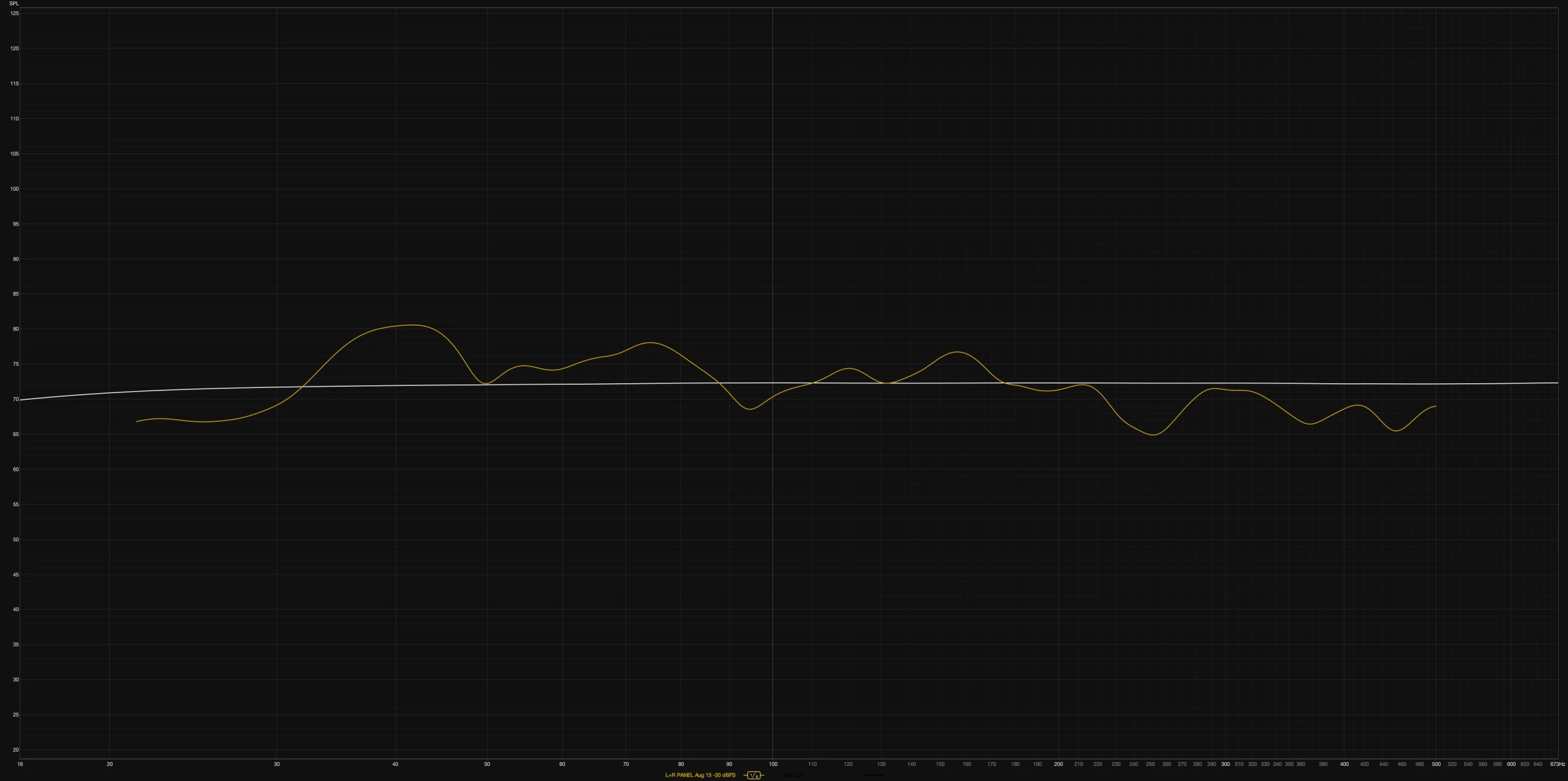
This graph shows the combined frequency response of the left and right speakers after C214 was added. The measurements below show how it compares with the room before treatment.
WHAT CHANGED
Five changes that mattered in this room.
The result was not perfect, but it was clearly better where the original room problem was most obvious.
shorter visible decay around 40 to 45Hz
visible tail reduction around 75 to 85Hz
substantial right-channel stored-energy reduction
shallower dips near 90Hz and 130Hz
SYSTEM AND ROOM
The system and room behind the measurement
Room
- Location
- Private two-channel listening room in Melbourne
- Room dimensions and construction
- Not published for client privacy
- Listening and loudspeaker positions
- Not published for client privacy
System
- Playback system
- High-end two-channel hi-fi system; individual component models are not published
- Loudspeakers, amplification and sources
- Not published for client privacy
- Subwoofer configuration
- Not published for client privacy
How we made the before-and-after comparison
We used Room EQ Wizard to compare combined left-and-right SPL, spectrogram views and a separate right-channel energy-time view. The SPL plots show how loud each frequency was at the microphone; the time-domain views show how long low-frequency energy remained in the room.
For client privacy, the published case does not include every room dimension, microphone detail or control setting. The graphs should therefore be read as a controlled comparison in this room, not as a universal performance specification.
BEFORE
Before: plenty of bass energy, but too much of it stayed behind
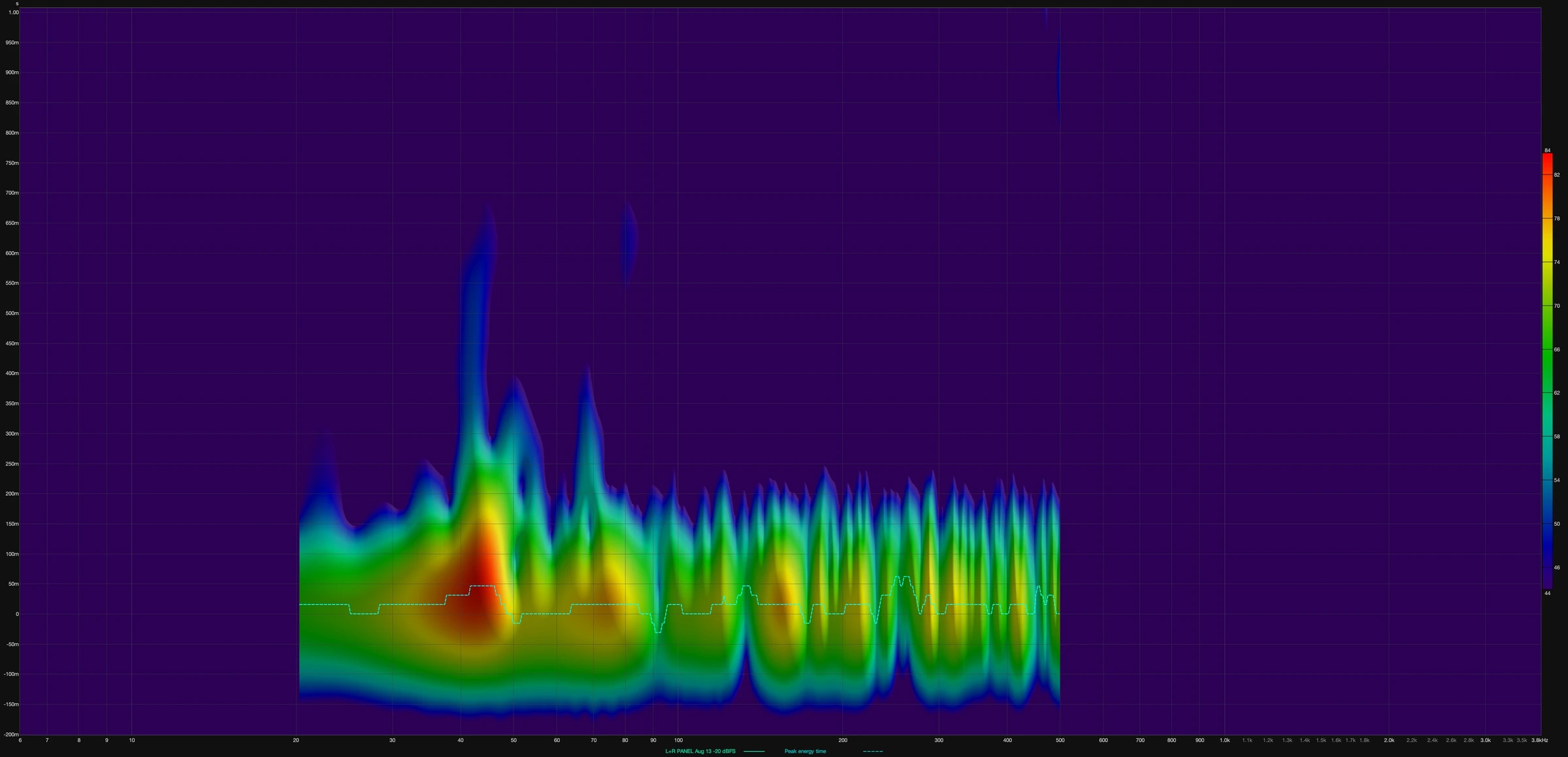
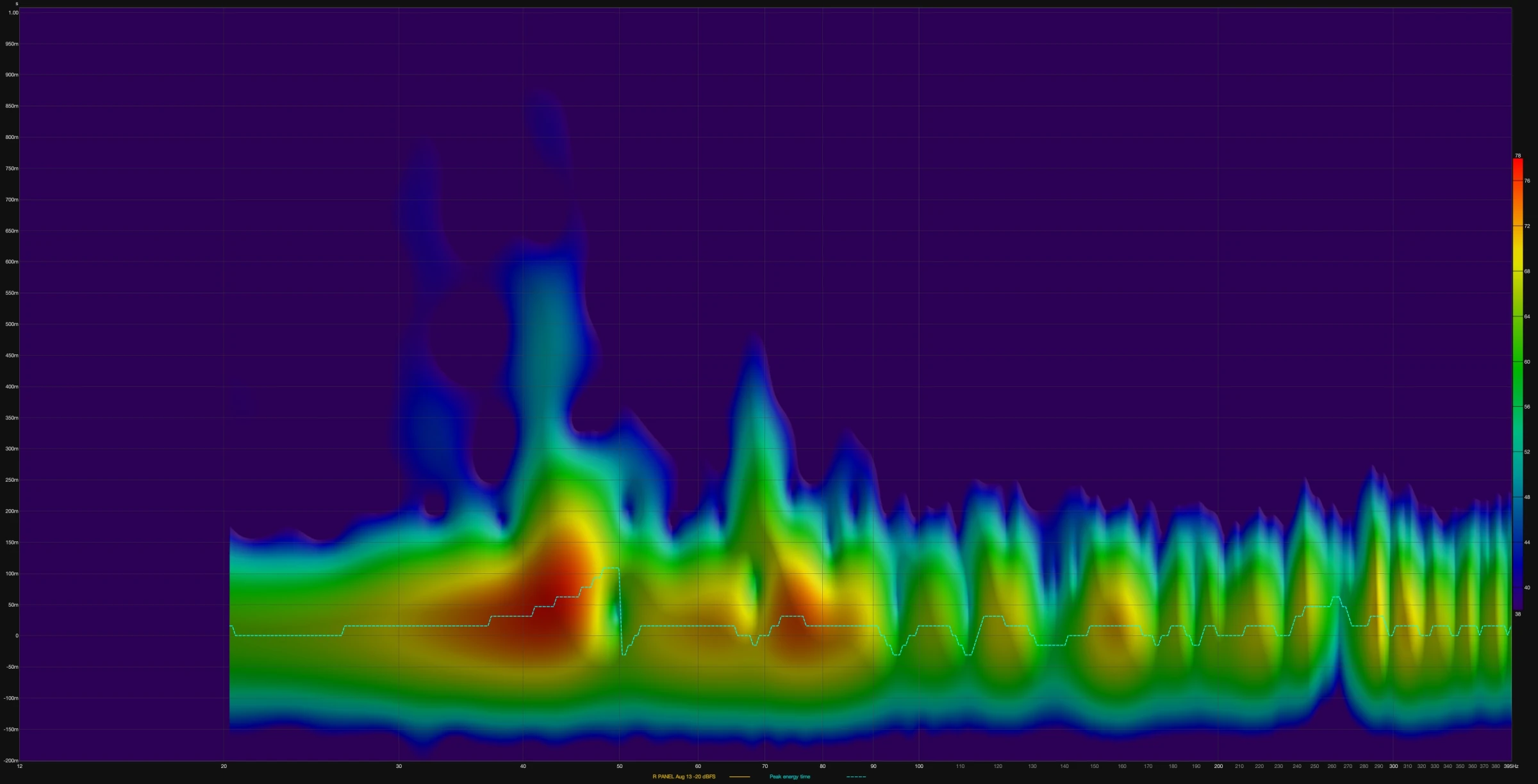
Before C214, the room showed a broad rise around 40 to 45Hz, another long-decay region around 75 to 85Hz, and even more stored energy in the right channel between roughly 30Hz and 45Hz.
That matters because bass can be “too much” in two different ways: too loud, or too slow to disappear. When the room keeps ringing, one bass note can blur into the next, kick drums lose their edge and voices or lower instruments become harder to separate.
01 · FREQUENCY RESPONSE
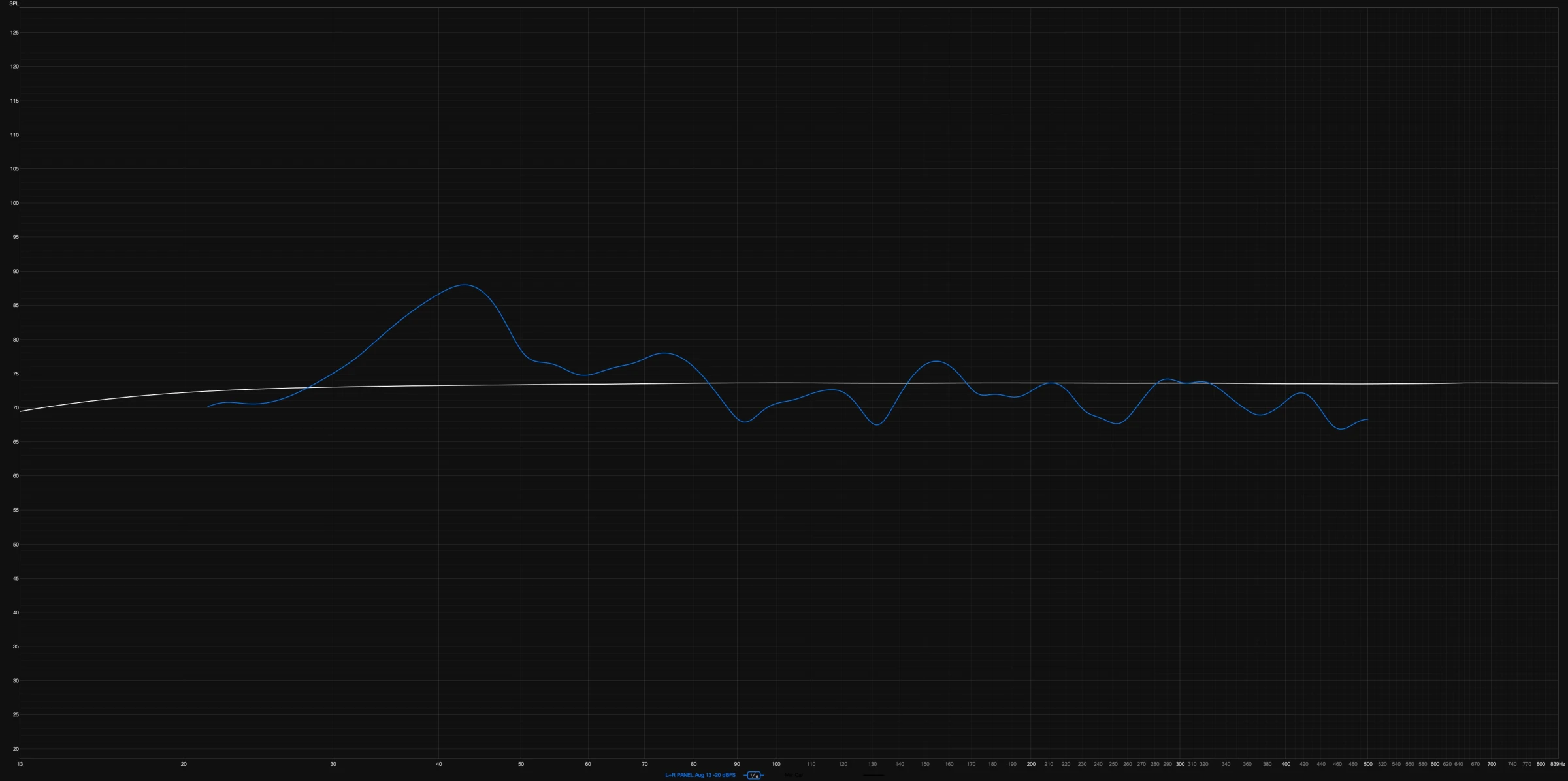
Combined L+R SPL
The combined left + right response establishes the starting point: a dominant 40 to 45Hz rise, followed by deeper troughs higher in the bass range.
BeforeOpen full measurement
02 · DECAY THROUGH TIME
Combined L+R Spectrogram
These views add time to frequency and level. Long streaks show slowly decaying energy; the dashed Peak Energy Time trace is not a decay curve.
BeforeOpen full measurement
03 · RIGHT CHANNEL
Right-channel Energy-Time
The right-channel comparison shows a substantial reduction in stored energy between 30Hz and 45Hz in this room.
BeforeOpen full measurement
Intervention: AVAA C214 added to the room
The AVAA C214 works as a pressure-based active bass absorber from 15 to 160Hz. It treats low-frequency energy in the room itself, without processing the signal from your DAC, preamplifier or loudspeakers.
C214 absorbs acoustic energy without an audio connection to the playback system. The comparison below shows the room response after it was added.
AFTER
After: lower peaks and shorter visible decay
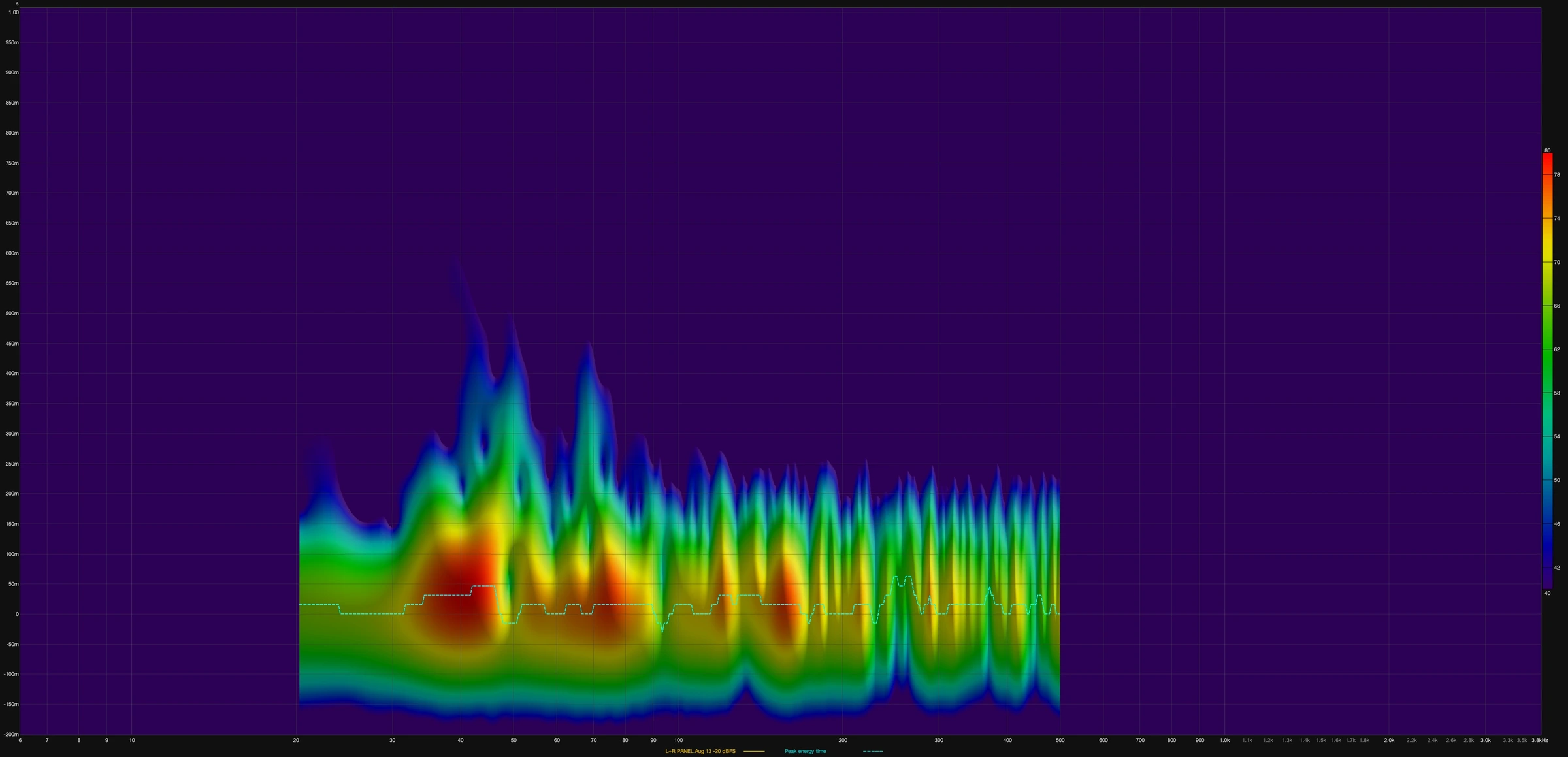
The dominant 40 to 45Hz peak fell by roughly 5 to 7dB, and visible decay in the same region shortened by approximately 100 to 220ms. Around 75 to 85Hz, the long tail reduced from roughly 650ms to approximately 265 to 370ms.
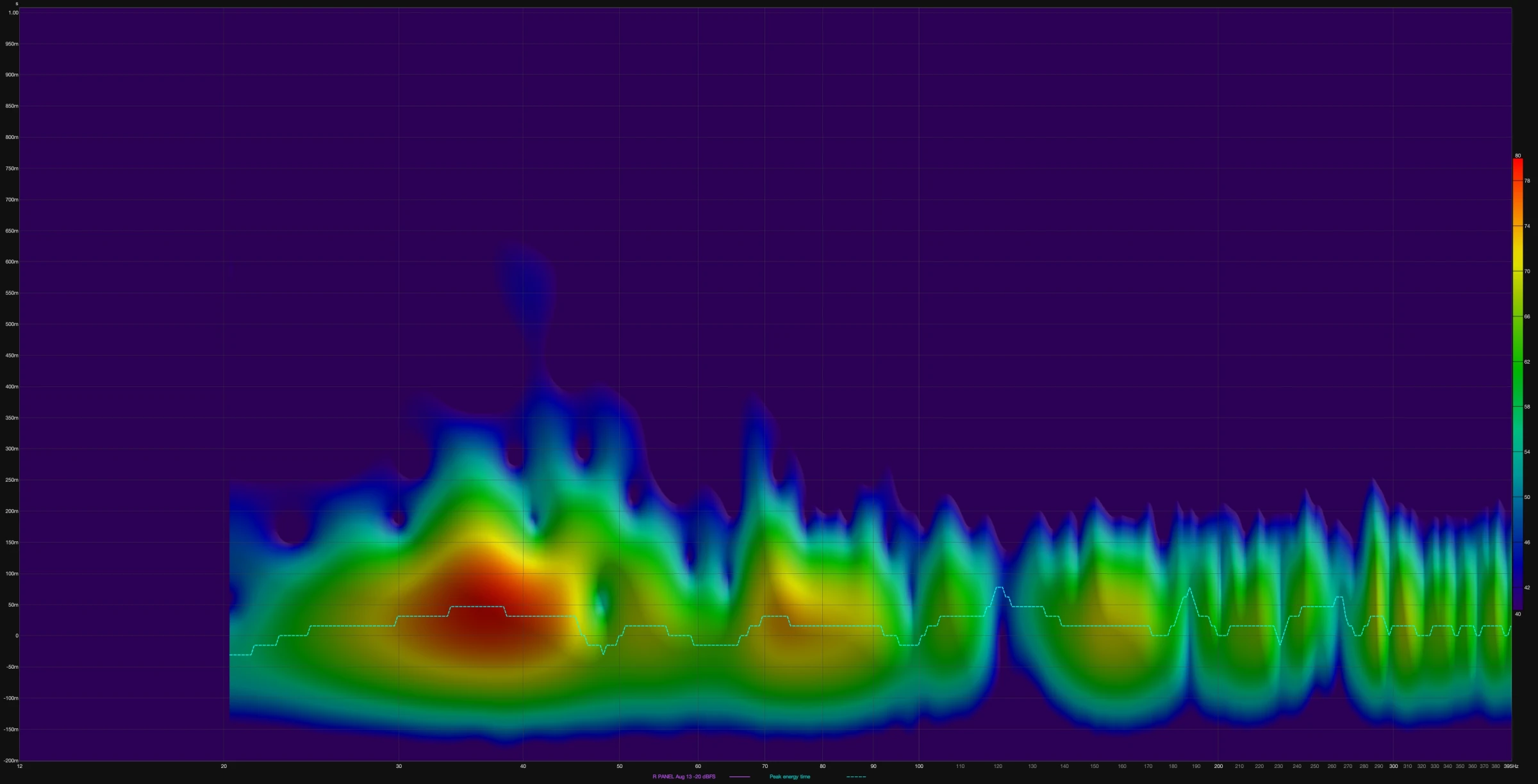
The right-channel comparison showed substantially less stored energy between 30Hz and 45Hz. Dips near 90Hz and 130Hz also became shallower by approximately 3dB and 5dB respectively. These figures describe this room and this comparison only.
01 · FREQUENCY RESPONSE
Combined L+R SPL
The combined left + right response shows the 40 to 45Hz peak reduced, with the dips around 90Hz and 130Hz becoming shallower.
AfterOpen full measurement
02 · DECAY THROUGH TIME
Combined L+R Spectrogram
These views add time to frequency and level. Long streaks show slowly decaying energy; the dashed Peak Energy Time trace is not a decay curve.
AfterOpen full measurement
03 · RIGHT CHANNEL
Right-channel Energy-Time
The right-channel comparison shows a substantial reduction in stored energy between 30Hz and 45Hz in this room.
AfterOpen full measurement
What these measurements are likely to sound like
The likely audible shift is not simply less bass. It is bass that starts and stops more cleanly: tighter kick-drum edges, clearer bass pitch, less low-frequency masking around voices and instruments, less congestion at higher playback levels, and a room that settles sooner.
These are possible listening effects inferred from the measurements. They were not recorded as the client’s listening impressions, and another room may sound different.
What still needed work after the improvement
C214 made a clear difference, but it did not make the room perfect. The 40 to 45Hz region remained elevated, some decay persisted around 48 to 52Hz and 65 to 75Hz, and the two channels did not benefit equally.
The dip around 250Hz also remained, which is outside the C214’s stated 15 to 160Hz operating range. That issue may need a different approach such as placement, loudspeaker or chair movement, subwoofer integration, broader acoustic treatment or carefully limited EQ.
The useful question is not whether C214 “fixes everything”. It is whether it meaningfully improves the problem that matters most in this room.
What this result means, and what it does not
The clearest changes in this room were a lower 40 to 45Hz peak and shorter decay around 75 to 85Hz. Some residual peaks and tails remained.
These results apply to this room and test setup. An in-home demonstration lets you hear the on/off difference in your own room and compare the accompanying measurements.
COMMON QUESTIONS
Five questions this real-room test helps answer
Does the AVAA C214 simply reduce bass output?
Not in the way an EQ applies a broad level cut. C214 absorbs excess room resonance and shortens decay. In this case, the 70 to 80Hz energy at the start of the event remained while the long tail became much shorter, the kind of change that can make bass feel tighter rather than thinner.
How is the C214 different from Dirac or parametric EQ?
Dirac and parametric EQ change the signal sent to the loudspeakers. C214 works on low-frequency pressure in the room itself. They can complement one another, but they act at different points in the system.
Can an active bass trap fix a deep bass null?
Not necessarily. A deep null is often a cancellation problem, so loudspeaker position, listening position, subwoofer placement or a multi-sub strategy may be the more effective route. C214 is better suited to excess resonance and slow decay.
Why does placement matter?
C214 responds to low-frequency pressure in the room, so its effect changes with position. Comparing practical locations with consistent listening and measurements shows where it is most useful.
Why measure with REW if the C214 requires no calibration?
C214 does not need a room-correction filter before it can operate, but REW tells us whether the problem is actually resonance, slow decay or cancellation, and whether the chosen position is improving the thing we wanted to improve.
WHAT TO DO NEXT
Want to know what C214 would do in your room?
If you are in Melbourne and already considering C214, the in-home demonstration is the most direct next step. If you are still researching, use the product and room-acoustics guides below.